

Accessing HaPI through Ovid
Ovid is an online, subscription-based research platform published by Ovid Technologies, a subsidiary of Wolters Kluwer.
Follow these steps to find instruments in HaPI
Start your HaPI search using Ovid
Once you’ve logged into HaPI through your institution, navigate to the Multi-Field Search. Enter your terms in the search bars and use the dropdown next to each one to choose which field to search – title, author, sample, and more. Click “Add row” to include additional terms, and use “AND/OR” to combine them for more precise results.
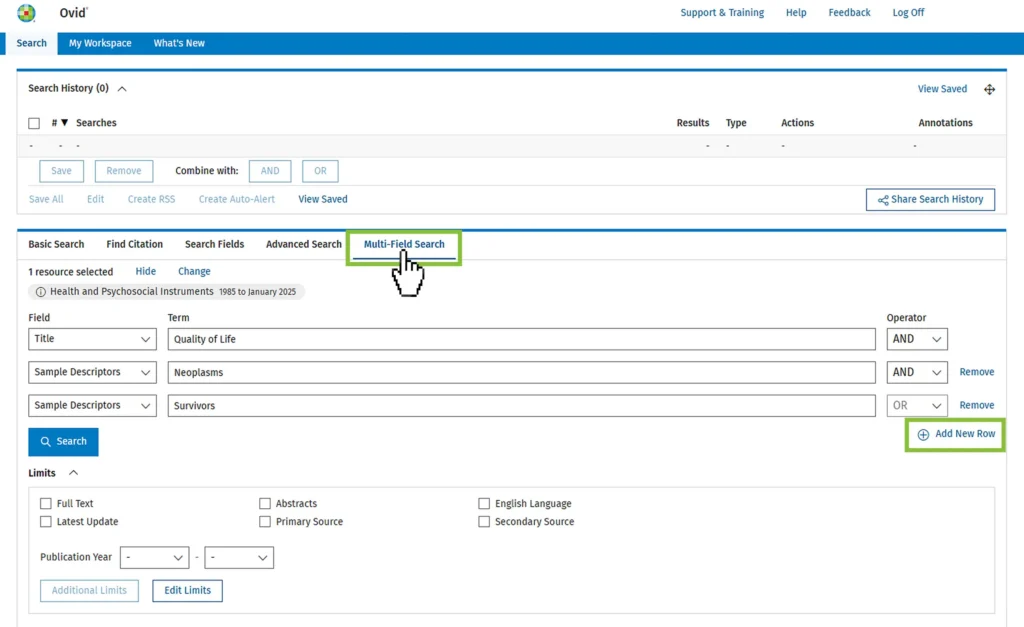
Narrow your search with HaPI’s descriptor fields
Use the Limits panel at the bottom of the search screen to focus your results. Select Primary Source to limit your search to records of the original publications of instruments. This can be combined with other options like Language or Publication Year. Once your limits are set, click Search.
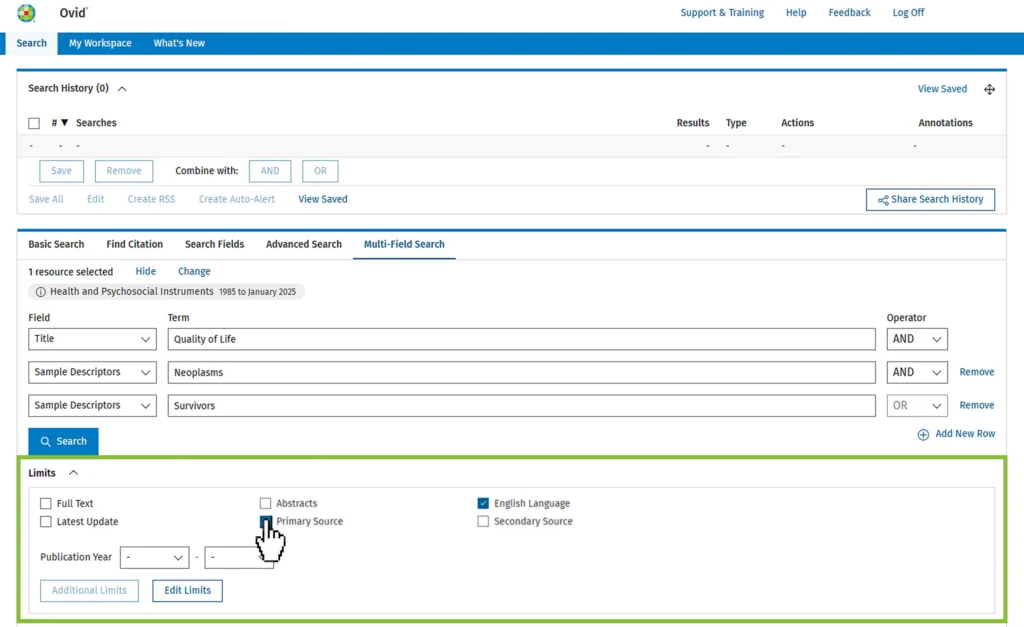
View your results and retrieve a full record
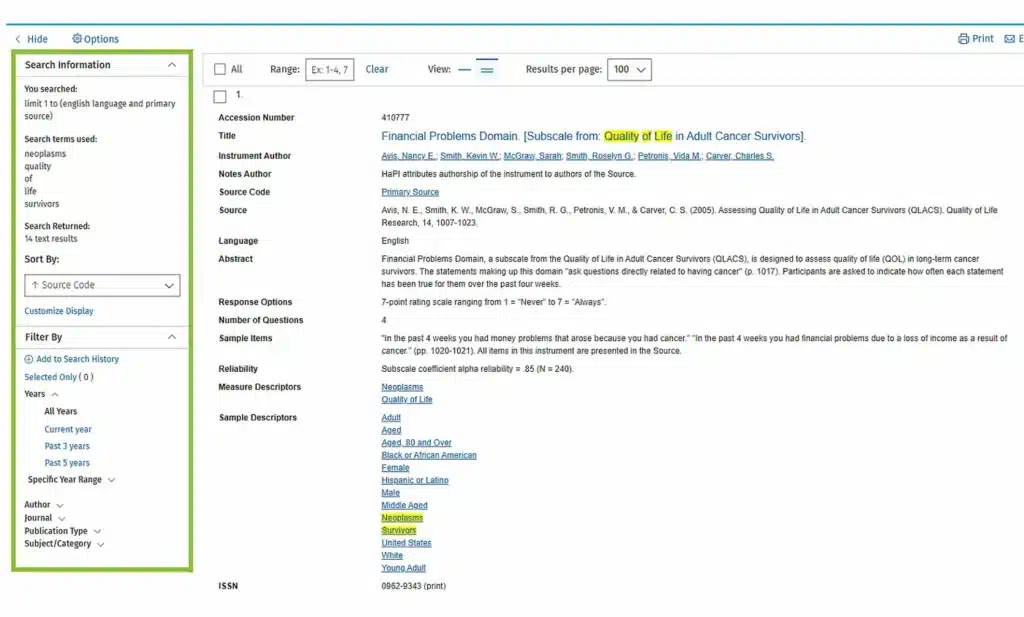
Results are displayed as a list of each instrument’s title, authors, and citation. Click a title to open its full record, where you’ll find additional details like acronym, abstract, number of items, subscales, descriptors, and reliability.

Refine results that need more focus
Narrow your results further by selecting characteristics like Published Date, Journal, Publication Type, or Subject/Category in the left-hand filter panel. Update your selections and click Search again to see your refined list.
Definitions of database fields and sample HaPI records
Frequently Asked Questions About HaPI
Have a question about HaPI? Browse our FAQs.
The Health and Psychosocial Instruments (HaPI) database is available through paid subscriptions at college and university libraries, medical schools and hospital systems, and other research organizations and institutions. It is accessed through the academic platforms of EBSCO or Ovid, depending upon your institution. Check the library at your institution or organization to see whether HaPI is available to you.
Yes, both Ovid and EBSCO offer free trials of HaPI through libraries at universities, medical schools, and other research organizations. The free trial would be accessed through EBSCO or Ovid. Contact your Ovid or EBSCO representative to request one.
HaPI does not offer direct access to the verbatim questionnaire through our records; instead, the database provides bibliographic citations to the source in which the measurement tool was first published and described.
Many times, these published sources contain a full copy of the instrument, in which case the “Sample Items” field in the HaPI record will state: “All items in this instrument are presented in the Source.”
In some cases, HaPI has obtained permission from the authors to distribute their instrument through our Document Delivery Service, in which case the “Availability” field in the HaPI record will state: “To obtain a copy of this instrument from Behavioral Measurement Database Services (BMDS), email us….”
Subscribers can make specific requests for copies of instruments at docdel@bmdshapi.com. Simply include the “Title” of the instrument and the “Accession Number.” These instruments are provided directly from HaPI at no cost to you. Note that you may need to obtain copyright permission directly from the author or publisher before using a specific instrument in your own research.
You can use the submission form found here.
HaPI covers measurement tools in medicine, nursing, psychology (including clinical, personality, social, and developmental), public health, social work, sociology, and organizational behavior.
With over 255,000 database records, HaPI includes instruments assessing a multitude of constructs, such as anxiety, child abuse, cognitive ability, depression, health status, job satisfaction, memory loss, pain, quality of life, social support, treatment compliance, and more.
HaPI contains measurement tools relevant to specific physical diseases (e.g., arthritis, asthma, brain injuries, breast cancer, cardiovascular diseases, chronic obstructive pulmonary disease, diabetes, dementia, HIV/AIDS, hypertension, kidney diseases, stroke) and specific mental disorders (e.g., ADHD, autism spectrum disorder, bipolar disorder, eating disorders, obsessive-compulsive disorder, panic disorder, personality disorders, post-traumatic stress disorder, psychotic disorders, schizophrenia).
Records provide detailed information about an instrument, including: the title of the instrument; authors; the bibliographic citation in which the instrument is described; the language in which the instrument was administered; and index terms.
Many records also include: an abstract describing the purpose of the instrument; response format; number of items; sample items; titles of subscales; reliability (e.g., internal consistency, test-retest reliability); validity (e.g., criterion, convergent, discriminant); and relevant references.
If you need assistance in selecting a measurement instrument, you can contact Behavioral Measurement Database Services (BMDS), the producer of HaPI. BMDS provides free, one-on-one assistance to users who need help selecting a measurement instrument. Our librarians and Ph.D. measurement consultants are available to answer questions about our instruments and help you find an instrument to meet your research needs.
HaPI Insights: The Art and Science of Measurement
View all Insights
Measures of Quality of Life and Well-Being: Tips on Finding the Most Suitable Instrument
Fred B. Bryant, Ph.D., Emeritus Professor of Psychology, Loyola University Chicago Linda…

How HaPI Measures Up
Fred B. Bryant, Ph.D., Emeritus Professor of Psychology, Loyola University Chicago Karen…

What Really Matters When Using Psychosocial Measurement Tools
Fred B. Bryant, Ph.D., Emeritus Professor of Psychology, Loyola University Chicago When researchers or…